


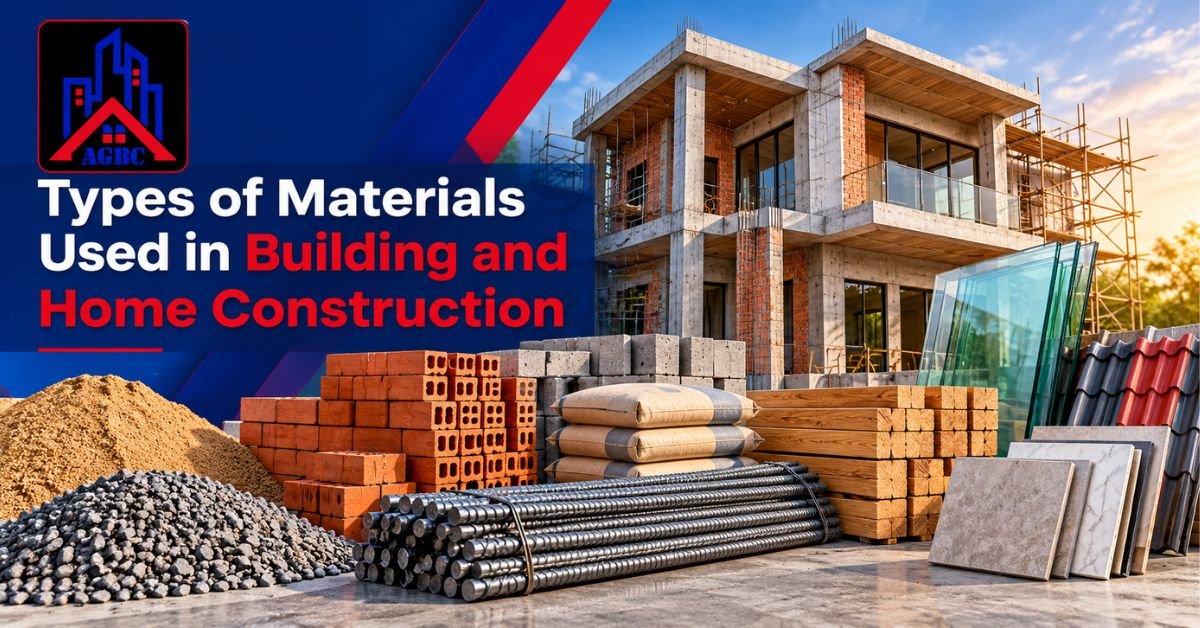
Cement bags, steel bars, stacked blocks, and drums of waterproofing liquid – you’ll see them at any construction site. They all have a job. If you choose the wrong one, you’ll pay the price years later, usually in the form of cracks or leaks.
This guide covers types of materials used in building houses, shops, and small commercial buildings. We referred to the Indian standards laid down by the Bureau of Indian Standards (BIS) and the building guidance of the central government. We also took a look at the product listings of AGBC (ApnaGhar BizCorp Pvt. Ltd.), which is a supplier based in Udaipur, so every product listed below is a real item from a real catalogue. Let’s take it apart.
What Materials Are Used to Build a House?
We need materials for five jobs in the house: to carry loads, to make walls, to finish surfaces, to keep water out, and to cover the roof. Here are the 12 building materials and their uses in the order most projects purchase them.
- TMT bars cement
- Mild steel pipes & sections
- AAC Bricks
- Concrete Bricks
- Bricks Fly Ash
- Panels of cement and Aerocon
- Plaster, putty and fibre mesh
- Waterproofing & construction chemicals
- Adhesives and floor coverings
- PUF panels for wall & roofing
- Water storage tanks and plumbing pipes
And each section below explains what the material is, what it does, and what to check before you buy:
Structural Materials That Hold the Building Up
Form is everything. Break any one of these three, and no finishing work will fix the problem.
1. Cement
Cement is a fine grey powder made by heating up limestone and clay in a kiln and grinding the result with gypsum. Add water, and it hardens due to a reaction called hydration. That reaction fuses sand and gravel into concrete, mortar, and plaster. Shree Wonder UltraTech Birla JK Super Cement Supplier from Udaipur
Cement is not a product. BIS has prescribed Indian Standards for 16 types of cement. IS 269:2015 is about Ordinary Portland Cement (OPC), and it has five grades: OPC 33, 43, 53, 43S, and 53S. Portland Pozzolana Cement (PPC) as per IS 1489 & Portland Slag Cement as per IS 455. And this is important. Different types react differently when they meet water, so ask your engineer which one the design assumes.
2. TMT Bars
TMT stands for thermo-mechanically treated. The bar is air-cooled and self-tempered. This process creates a hard outer skin and a softer, bendable centre. The surface ribs grip the concrete, and the low carbon content means that you can weld the bar without cracking it.
The grade name indicates the strength. According to IS 1786:2008, the number after “Fe” is the minimum yield stress in N/mm². So Fe 500 starts at 500. The bar stretches further before it snaps, with the same yield stress but a higher minimum elongation, so a “D” is added after the number, for example, Fe 500D. The AGBC catalogue has bars of Fe 415 to Fe 600 from Tata Tiscon, SAIL, JSW Neosteel, Kamdhenu, Vizag, PAN and Rathi brands.
Accessories are also very important. Couplers are used to join two bars end to end, in sizes from 12 mm to 32 mm. Tie bars are tied with binding wire where they cross. Cover blocks space the steel from the formwork so that concrete can surround it. Nominal cover is based on exposure conditions, as that layer protects steel from corrosion and fire. IS 456:2000 gives.
3. Mild Steel Sections and Pipes
Not all steel is in concrete. Mild steel (MS) is used in gates, staircases, sheds, light frames and window grills. The supplier lists MS channels, purlins, angles, flats, round bars, pipes and rectangular hollow sections. The channels, beams and flats are said to be to IS 2062. The beams are fabricated from low-carbon steel containing 0.1% to 0.25% carbon. The metal’s low carbon level makes it easy to cut, bend, and weld.
Write down the grade, size, and wall thickness when you order.
Walling Materials: Blocks, Bricks and Panels
Walls cover more square footage of a home than any other part. There are 4 options in common.
4. AAC Blocks
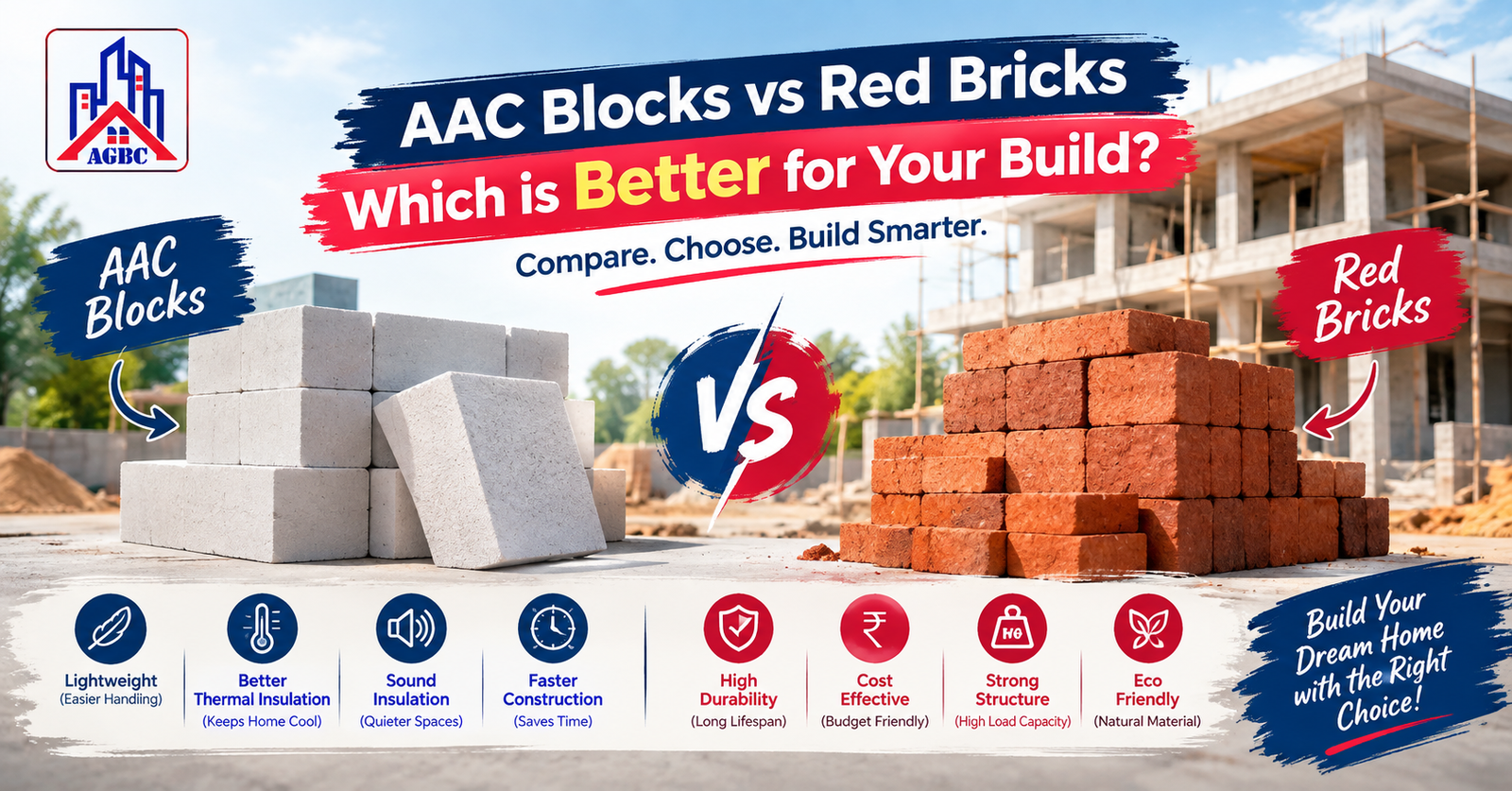
AAC stands for autoclaved aerated concrete. Manufacturers cure these blocks in high-pressure steam, leaving little air pockets inside. The block is much lighter than solid concrete, so the walls put less load on the columns and foundation. The air pockets also help the wall to resist heat, sound and fire.
These blocks are covered in IS 2185 (Part 3) by BIS. The standard applies to blocks having a density up to 1 000 kg per cubic metre and grades them into two grades according to compressive strength. The supplier also mentions block adhesive, which sticks AAC blocks together with a thin layer, as an alternative to a thick bed of sand-cement mortar.
5. Concrete Blocks
Concrete blocks are precast units of cement, sand, aggregate, and water. They are also used in load-bearing walls, non-load-bearing walls, and foundations. They are hard to beat and are offered in both hollow and solid styles. Both are BIS standard IS 2185 (Part 1). Ask about the block grade before ordering.
6. Fly Ash Bricks
Fly ash is a waste product formed in thermal power plants. The manufacturers mix it with cement, sand, and water, then press it into bricks and steam-cure them. The finish is smooth to the touch and reduces the amount of plaster that you need. These bricks recycle industrial waste, too.
Policy matters as well. A notification issued in 1999 by the Ministry of Environment, Forest and Climate Change (MoEF&CC) and amended since makes it mandatory for construction agencies within a 300 km radius of coal or lignite power plants to use fly ash-based products. Check with your local authority to see if your site is in that radius.
7. Cement Panels and Aerocon Panels
Cement panels are boards made of precast cement, sand and reinforcing fibres. Some are flat. Other ones are sandwich panels with lightweight concrete in the middle and a fibre cement sheet on each side. Aerocon panels fall into that second group.
The supplier says these panels are resistant to water, fire, and termites. They are also lighter than brickwork, which reduces the structural load. Panels have fixed sizes, so they may speed up partition work.
Finishing and Protection Materials for Home Construction
These home-building materials determine the appearance of a house and how long it remains that way.
8. Plaster, Putty and Fibre Mesh
A rough wall covered in plaster. It is then smoothed with putty to prepare it for painting. Supplier lists gypsum plaster, ready-mix cement plaster, wall putty and fibre mesh rolls.
Gypsum plaster is good for interior walls and ceilings. It sets quickly. Ready-mix cement plaster is a factory mix of cement, graded sand, and polymers, so you just add water. That takes the guesswork out of on-site mixing. Wall putty is a white cement-based powder that fills up pores and fine cracks before painting. The fibre mesh is embedded into the plaster layer to spread stress from shrinkage and movement.
9. Waterproofing and Construction Chemicals
Water damages buildings slowly and then all at once. Construction chemicals slow that damage.
Zydex’s Zycosil Plus and Zycosil Max are silane-siloxane liquids that penetrate concrete and brick to create a breathable barrier. ElastoMax is a flexible coat for terraces, classified for bridging cracks up to 2.5 mm. Zycrete 2X is used as an admixture in concrete or mortar mixes, and the listing says it reduces water demand by 15 to 20 per cent. ColdBond helps new and old concrete bond at joints.
Fibres should also be here. Recron 3S, Gujcon, KDM glass fibre, and Strongplast polypropylene fibre control micro-shrinkage cracks in concrete & plaster. The Pidilite Terminator is for termite protection, and Dr Fixit is on the supplier’s homepage for waterproofing.
10. Adhesives and Flooring Materials
Plain mortar is not enough for tiles and blocks. Tile adhesives are a blend of cement, polymers, and fillers. This provides a much better grip, flexibility, and water resistance than cement mortar. MYK Laticrete – Tile Adhesives, Grouts and Waterproofing Systems. Its L-310 epoxy adhesive spot-bonds heavy tiles, marble and granite to walls and overhead surfaces.
Sika Chapdur is a dry-shake mineral hardener for warehouse and parking floors. Workers spread it on fresh concrete to create a dense surface that resists abrasion and dust.
Roofing and Plumbing Materials
11. PUF Panels for Roofing and Walls
PUF is an acronym for polyurethane foam. A PUF panel is a prefab sandwich panel with a foam core and is lightweight. The supplier lists Rinac PUF panels for roofs, walls, ceilings, and floors for industrial, commercial, and modular buildings.
Insulation is important in hot weather. The government’s training material for the Energy Conservation Building Code 2017 lists roof and wall insulation as ways to increase thermal resistance and states that a lower U-value means better insulation. Before you start comparing your options, ask the seller for panel thickness and thermal data.
12. Plumbing Pipes and Water Tanks
Plumbing is hidden in walls, so mistakes cost the most to fix. The supplier offers Jain Plumbing, Ashirvad and Supreme pipes in SWR, CPVC and UPVC. SWR pipes are used to transport soil, waste, and rainwater. Water supply pipes are CPVC and UPVC, and CPVC is used for hot water.
The range for GI lines is Tata B Class (medium) and C Class (heavy) pipes made to IS 1239 and UNIK GI fittings threaded to IS 554. The heavy class pipes have thicker walls. HDPE water tanks are UV-protected for above-ground & underground installation and rainwater harvesting.
How to Choose Building Materials: Next Steps
Use this short checklist before placing an order:
- Begin with the structural drawing. It specifies the cement type, steel grade, and block size. Do not sell grades for money.
- Match the material with its exposure. Match the proper cover to the waterproofing. Terraces, bathrooms, and ground-level walls face the most water.
- Read the product standard. Look for IS numbers like IS 1786 for TMT bars, IS 2185 for blocks, and ask for test certificates.
- Compare apples to apples. Brand, grade, size, and thickness – check them side by side before you compare price.
- Buy matching accessories at the same time. The final result is affected by block adhesive, tile adhesive, binding wire, and cover blocks.
Before You Buy
Knowing the materials used in construction makes every talk with an engineer, a contractor or a supplier easier. Begin with the structure, make it waterproof, and then finish the surfaces. To see brands, sizes and catalogues for each material, browse the building material pages at AGBC.
FAQs
What materials do you need to build a house?
You will require cement, TMT bars and sand for the structure; blocks or bricks for the walls; plaster and putty for finishing; waterproofing for the terrace and bathroom; and pipes for plumbing. Roofing and flooring materials finish the list.
What cement grades does BIS list for OPC?
IS 269:2015 specifies five grades of Ordinary Portland Cement, viz.: OPC 33, OPC 43, OPC 53, OPC 43S and OPC 53S. BIS also publishes separate standards for blended cements like PPC and slag cement. The grade is selected from the design by your engineer.
What does the ‘D’ in ‘Fe 500D’ mean?
The D represents a bar with the same minimum yield stress as Fe 500 but with a higher minimum elongation. In layman’s terms, a Fe 500D stretches more before breaking. IS 1786:2008 defines the letter. Ask your engineer if required by your design.
Why do TMT bars need cover blocks?
The cover blocks keep a constant distance from the steel to the face of the concrete. Concrete in that space protects the bars from moisture and fire. IS 456:2000 specifies the cover required for exposure conditions, and cover blocks make it easy to hold that gap.
Are fly ash bricks and AAC blocks the same?
No, fly ash bricks are made by pressing fly ash, cement, sand and water. AAC blocks are steam-cured aerated concrete and are much lighter. Both are steam-cured but are different in weight, size, and internal make-up.


Leave a Reply