


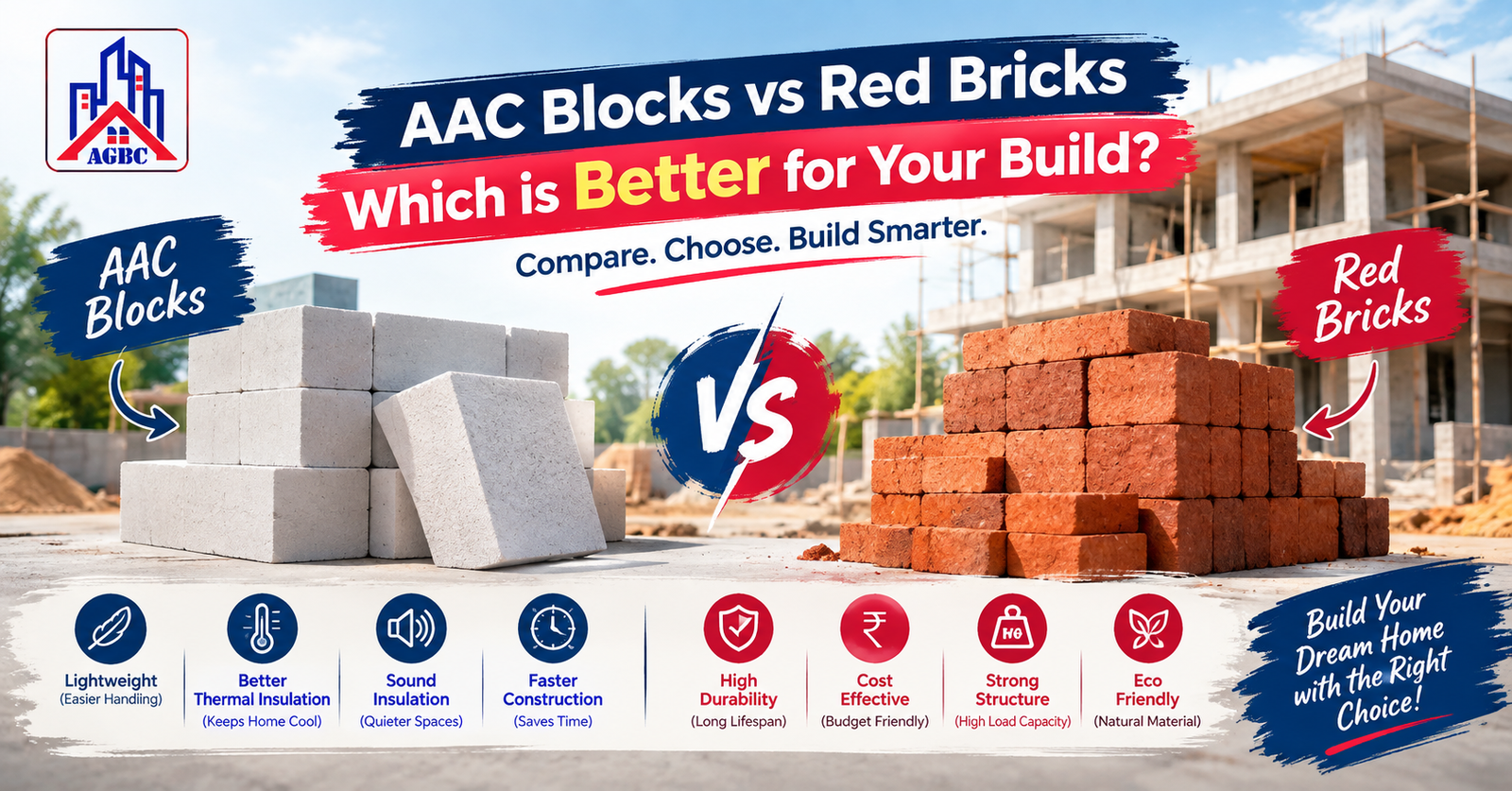
When planning a residential or commercial construction project, choosing the right walling material is an important decision to make. For many decades, red bricks have been a very common material in Indian construction, but now AAC blocks are gaining popularity as a lighter option.
Both materials have their own characteristics, advantages, cost considerations, and applications. Builders and homeowners should consider not only the cost of the material but also the costs of transportation, mortar, labour, speed of construction, and the entire walling system before making a decision.
If you are planning to draft construction plans in Udaipur, then knowing the AAC blocks price and comparing it with the total cost of red brick masonry will help you plan your material budget efficiently.
This guide compares AAC blocks and red bricks on cost, weight, installation, thermal performance, durability, and practical construction considerations.
Also Read: 7 Stainless Steel Kitchen Essentials Every Indian Home Needs
What are AAC blocks?
AAC means Autoclaved Aerated Concrete. AAC blocks are lightweight precast building blocks made from cementitious materials, fine aggregates or sand, lime, gypsum, water, and an aerating agent. They are cured in an autoclave under controlled conditions.
AAC blocks are much lighter than conventional clay bricks for equivalent walling applications because of their cellular structure.
AAC blocks are most often used for:
- External walls
- Internal partitions
- Housing construction
- Business buildings
- Institutional buildings
- Skyscraper building
- Lightweight walling systems
Their lower weight makes them an important option among lightweight walling solutions in India.
What Are Red Bricks?
Red bricks are traditional masonry units that are generally made from clay or other earth-based raw materials and fired in a kiln.
They are used extensively in Indian construction for:
- Residential Houses
- Walls, boundary
- Interior Walls
- Exterior walls
- Small commercial buildings
- General Masonry
Red bricks are easily obtainable in many areas and are familiar to local masons and contractors.
However, the quality and size of red bricks may differ depending on the manufacturer, process, and source.
AAC Blocks Cost: Influencing Factors
The cost of AAC blocks is determined by several factors, like size, density, grade, manufacturer, quantity, transportation, location, and supplier.
If you are comparing AAC blocks, don’t just compare the price of one block. It may be more useful to compare the cost per square metre or square foot of finished wall.
Factors that can affect the price of AAC blocks are:
| Factor | Impact on Price |
| Block size | Larger blocks may have a different per-piece rate. |
| Density | Different densities may have different prices. |
| Brand | Manufacturers can influence pricing. |
| Quantity | Bulk orders may have different rates. |
| Transportation | Freight affects delivered cost. |
| Location | Local market rates can vary. |
| Mortar system | AAC blocks may require suitable jointing materials. |
Ask the supplier for a quotation that clearly states the block size, quantity, transportation, taxes, and any other applicable charges before you order.
Price of AAC Blocks Per Piece, Udaipur
If you are looking for the AAC block price per piece in Udaipur, then remember that there is no single rate applicable to all AAC blocks.
The price per piece may vary depending on:
- Block size
- Density Manufacturer
- Quantity Ordered:
- Supplier pricing, transport, GST, delivery location
For example, you can’t compare a larger AAC block and a smaller AAC block just on their per-piece price. Each will take up a different wall area.
The best way is to work out the cost per square metre or square foot of wall construction, taking into account the price of the block, the mortar, the labour, and wastage.
Cost Comparison of AAC Blocks and Bricks
A proper AAC blocks vs bricks cost comparison should go beyond the purchase price of individual units.
The total cost of walling may include:
- Cost of materials, transport
- Loading and Offloading
- Mortar or adhesive, labour, plastering, wastage, handling, construction time
AAC blocks are larger than standard bricks, so you may require fewer units to cover the same wall area. They are also easier to handle because they are light.
Red bricks, in contrast, are ubiquitous and may have familiar supply chains and established labour practices in many locations.
The cheaper material per piece is not necessarily the cheaper finished wall.
| Feature | AAC Blocks | Red Bricks |
| Weight | Lightweight | Heavier |
| Unit size | Generally larger | Generally smaller |
| Wall construction | Fewer units required | More units required |
| Handling | Relatively easier | More labour-intensive |
| Mortar | Often uses thin-bed adhesive/jointing material | Conventional mortar commonly used |
| Thermal insulation | Generally good due to cellular structure | Depends on brick properties and wall design |
| Availability | Increasingly available | Widely available |
| Cost comparison | Should consider complete walling cost | Should consider complete walling cost |
| Application | Residential, commercial and other construction | Residential, commercial and general masonry |
- Cost comparison: full walling cost to take into account Full walling cost to take into account application Residential, commercial and other buildings Residential, commercial and general masonry
Actual performance is subject to the specific product, wall thickness, workmanship, climate, and overall building design.
Weight of Red Bricks and AAC Blocks
The weight of the two materials is one of the biggest differences.
AAC blocks are cellular in their internal structure, which makes them tremendously lighter than the regular masonry units. This can decrease the dead load of the walls.
Red brick is comparatively heavy, and a wall built of it can add to the dead load on the building.
Reduced wall weight may be beneficial in multi-storey construction and in projects where a reduction in structural dead load is part of the design strategy.
But structural design should always be done by a qualified professional. The choice of the wall material should be done along with the structural system of the building.
Building Pace
AAC blocks are larger than standard bricks. This means a mason can cover a greater area of wall with fewer individual blocks.
This can increase masonry productivity when blocks, jointing material, tools, and workmanship are managed properly.
Red brick masonry generally requires more units to construct the same area of wall.
The actual construction speed depends on:
- Mason’s skill
- Dimensions of blocks or bricks
- Wall Plan
- Availability of Materials
- Jointing technique
- Site Condition
- Number of employees
So the material itself doesn’t determine the final construction schedule.
Mortar and Grouting Requirements
AAC blocks are most commonly laid with thin-bed adhesive or other suitable jointing material, rather than the relatively thick conventional mortar joints widely used with red bricks.
Thin joints, when properly installed, can reduce the amount of jointing material and may help create a more uniform wall surface.
The most used mortar for red brick masonry is cement-sand mortar.
The exact material and method of application shall be as recommended by the block or brick manufacturer and the construction specifications.
Heat Performance
The AAC blocks have a porous cellular structure which provides relatively good thermal insulation compared to many conventional dense masonry materials.
This can help to reduce heat transfer through walls. However, the thermal performance of a building depends on much more than wall material.
Includes factors such as:
- Thickness of wall
- Design of windows
- Orientation of the building:
- Roof framing, insulation, ventilation
- Shading, external
- Climate local
In hot regions, such as parts of Rajasthan, the overall building envelope has to be considered in the selection of walling materials.
Fire Resistance
AAC is an inorganic, non-combustible building material. AAC is often used in applications requiring fire-resistant wall assemblies.
But the fire performance depends on the thickness, density, system of construction, and tested assembly.
Red brick is also a noncombustible masonry material and has long been used in fire-resistant construction.
Look to the tested system specifications and applicable building codes for any given project.
Strength and durability
Both AAC blocks and red bricks can be used to construct durable buildings provided the correct product is selected and the masonry is well designed and constructed.
Durability depends on such factors as:
- Material quality of the
- Strength and density
- Water uptake
- Design Wall
- Adhesive or cement
- The workmanship
- Protection from moisture
- Plastering and finishing
AAC blocks should be protected and installed as per the manufacturer’s recommendations, especially regarding exposure to moisture and finishing.
Red bricks manufactured, stored, laid, and protected from excessive moisture shall be in a proper manner.
AAC Blocks: Lightweight Walling Solutions in India
As builders look for construction systems that reduce wall weight and improve construction efficiency, the need for lightweight walling solutions has increased in India.
AAC blocks can provide several advantageous properties.
Structures, Lightweight
They can be less dense and may balance the dead load from masonry walls.
Bigger Block Size
Larger dimensions may reduce the number of units required for a wall.
Easier to manage
They are lighter in weight, and individual blocks may be easier to handle than heavier masonry units.
Heat Insulation
The cellular structure may provide thermal insulation properties.
Productivity in Construction
Masonry work can be done faster with AAC blocks, because fewer units are needed if they are properly installed.
The benefits of these must be balanced against the project-specific requirements, the availability of materials, the skills of labour, and the total cost.
The Cheapest Way?
The question of whether AAC blocks or red bricks are cheaper for every project has no single answer.
For a correct comparison, calculate.
Total walling cost = Material + Transport + Jointing/Mortar + Labour + Plastering + Wastage
The per-piece price of AAC blocks can be higher or lower depending on the market, but their larger size and lighter weight can impact labour and transportation costs.
In some markets, red bricks may be lower in price per piece but may require more pieces and conventional mortar.
The result depends on local prices and project conditions.
AAC Blocks vs Red Bricks: Which One to Choose?
Please consider the following factors before you make your decision.
1. Type of Project
Find out if you are constructing an independent house, flat, commercial building, industrial plant, or partition wall.
2. Structural Design.
The material used for walling should be in keeping with the structural and architectural design.
3. Availability locally
Check which material is readily available in your area and if a consistent supply can be maintained.
4. The total cost
Compare the total installed wall cost, not the material purchase price.
5. Supply of labour
Check with your local masons if they have experience installing AAC blocks with the recommended system.
6. Building performance
Think about thermal performance, wall weight, fire performance, moisture protection, and other needs.
7. Reliability of Supplier
Select a supplier who can provide you with consistent quality material, correct quantities, and proper delivery support.
How to Buy AAC Blocks in Udaipur: Tips
Considering buying AAC blocks in Udaipur? Here are some things to keep in mind:
- Verify block dimensions before ordering.
- Check the manufacturer’s specifications.
- Request the price of current AAC blocks.
- Compare the delivered price, not just the factory or dealer price.
- Check with your contractor for how much is needed.
- Check block condition on receipt.
- Prevent blocks from unnecessary handling damage.
- Use the recommended adhesive or jointing compound.
- Installation: Follow the manufacturer’s instructions.
- Compare the cost of the walling with alternatives.
Depending on the supplier and the order size, you may also find that you are able to negotiate better commercial terms by buying in bulk.
Comparison of AAC blocks and red bricks – common mistakes to avoid
Don’t settle for one factor.
Frequent mistakes are:
- Just price per piece comparison
- Disregarding block sizes
- Excluding transportation
- No labour costs
- Cost of forget mortar/adhesive
- Not checking product specifications.
- Material selection without wall design consideration
- Improper jointing materials used
- Employing workers without experience of the selected system
- Ignoring moisture protection and finishing needs
Unit price comparison is a less clear picture than a complete cost and performance comparison.
Also Read: TMT Bar Price in Udaipur: 2026 Complete Buying Guide
Final Thoughts
AGBC AAC blocks and red bricks are both used for the construction of buildings, but they differ in their properties. Lightweight and larger in size, AAC blocks are extensively used in modern walling systems. Red bricks are also a popular traditional masonry option, readily available.
While comparing AAC blocks’ price per piece in Udaipur, you should not forget that individual unit prices do not tell the whole story. A good cost comparison of AAC blocks and bricks should consider the cost of material, transportation, labour, mortar or adhesive, wastage, and finishing.
AAC blocks can be considered for lightweight walling solutions for projects in India where their properties and installation requirements match the building design. The final choice should be based on the project specifications, local availability, total cost, and the advice of the architect or the structural and construction professionals involved.
Frequently Asked Questions
1. What is the price of AAC blocks in Udaipur?
Ans: AAC Blocks Price varies depending on block size, density, manufacturer, quantity, transportation, GST, and supplier. Get a fresh quote for the exact block specifications you need.
2. What is the AAC block price in Udaipur per piece?
Ans: The price per piece depends on the size, density, brand, quantity, and destination. You cannot use per-piece pricing to directly compare larger blocks of inventory to smaller blocks.
3. Cost of AAC block over red brick?
Ans: The answer depends on local prices of materials and total construction costs. Before deciding, compare the costs of the material, transport, labour, mortar or adhesive, wastage, and finishing.
4. What does an AAC blocks vs bricks cost comparison include?
Ans: To compare them fully, you would need to factor in the price of the material, transportation, jointing material, labour, wastage, plastering, and other installation-related costs.
5. Can I construct my home using AAC blocks?
Ans: AAC blocks are commonly used in the construction of houses. Local conditions, product specifications, building design, wall requirements, and proper installation are factors that determine their suitability.



Leave a Reply