


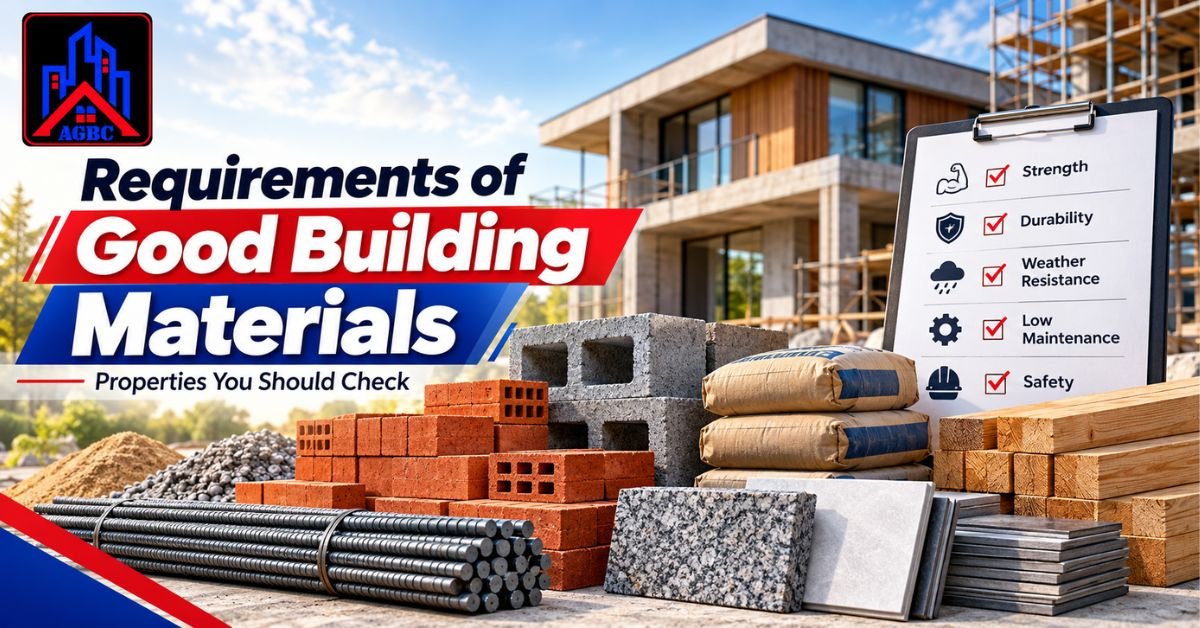
Every builder asks the same question before an order: is this stuff really good? The honest answer is: it is contingent upon the job. A block suitable for an inner partition may not be suitable for a compound wall. What works on a terrace might not work in a bathroom. Still, good materials have a short list of properties, and you can check each of them before you pay for them.
This guide describes in simple language what good building materials should be like. We show you where the property appears in the product range of AGBC, an Udaipur-based supplier, so you can see real examples of each property. We also rely on Bureau of Indian Standards (BIS) documents, a government energy-code training deck, and the supplier’s own product pages. Let’s break this down.
Quick Answer: 10 Properties of Good Building Materials
- Strength
- Durability
- Water resistance
- Thermal insulation
- Fire resistance
- Low weight
- Workability
- Dimensional stability and crack resistance
- Corrosion and pest resistance
- Standards compliance and consistency
How the Requirements of Good Building Materials Are Set in India
This is not a matter of opinion in India. Building materials are part of the National Building Code of India 2016 issued by BIS. This part covers the requirements of building materials and components and the criteria for acceptance of new or alternative materials, BIS says. Structural design and fire and life safety are discussed in separate parts.
Individual Indian standards are at the bottom of the code. How they work is shown in the BIS cement compendium. Each standard specifies rules for raw materials, manufacture, testing, packaging, and marking and then sets minimum numbers a product must reach. So when someone says a material is ‘good’; ask a sharper question: good against what standard, and for what job?
The 10 Properties, One by One
1. Strength
Strength is the load a material can carry before it fails. It shows in concrete and steel. IS 269:2015 covers five OPC grades. The grade number is the minimum 28-day compressive strength in MPa. So OPC 43 must reach 43 MPa, and OPC 53 must reach 53 MPa. The number after “Fe” represents the minimum yield stress in N/mm² according to IS 1786:2008 for reinforcement.
UltraTech, Wonder, Shree, Birla, and JK Super Cement and TMT bars in grades from Fe 415 to Fe 600 have been listed by the supplier. Check the grade marking on the bag or bar and the mill test certificate for steel. On the homepage, it says these certificates are supplied with wholesale supplies.
2. Durability
Materials that work through weather, wear, and time. In concrete, the concrete layer around the steel affects durability. As this layer protects the bars from corrosion and fire, IS 456:2000 specifies nominal cover based on exposure conditions. The supplier lists blocks from 20 mm to 75 mm to hold that gap in place.
The supplier lists HDPE water tanks outdoors with UV protection and galvanised iron pipes made to IS 1239. Check the direction of your part of the building, then select the covering and material accordingly.
3. Water Resistance
Water is the slow enemy of most buildings. Good materials will either resist it or shed it. From the supplier: Zydex’s Zycosil Plus and Zycosil Max are silane-siloxane liquids that penetrate concrete and brick and create a breathable barrier. For terraces, it mentions ElastoMax, a flexible coating rated to bridge cracks up to 2.5 mm. Waterproof cement boards. Dr Fixit for waterproofing.
These are from product listings, so take them as manufacturer claims. Check the coverage per litre, the number of coats, and the maker’s recommended primer.
4. Thermal Insulation
Insulation slows the heat flow, and that’s important in hot climates. Government training material for the Energy Conservation Building Code 2017 lists roof and wall insulation as ways to increase thermal resistance and says that a lower U-value means better insulation. The supplier says AAC blocks are thermally insulating and lists Rinac PUF panels for roofs, walls, ceilings and floors. Check: block grade, thermal data, seller panel thickness.
5. Fire Resistance
A good wall slows the fire. The supplier calls AAC blocks a fire-resistant wall and says cement panels resist fire. Fire and life safety are covered in their own section of the National Building Code. Your engineer or architect will need to verify fire ratings for walls, doors, and shafts in your plan. Check: Whenever your plan calls for a fire rating, ask for it in writing.
6. Low Weight
Lighter materials will reduce the load on columns and foundations. BIS covers AAC blocks under IS 2185 (Part 3). It covers blocks with a density of up to 1,000 kg per cubic metre and classifies them into two grades according to their compressive strength. The supplier supplies the AAC blocks. The homepage mentions an IS 2185 certification. Cement panels are also said to be lighter than masonry. Check the block grade and density against your structural design; lighter is not always suitable for each wall.
7. Workability
A badly-used material is difficult to use. Ready-mix cement plaster is a factory mix of cement, graded sand, and polymers to which you only add water. Block adhesive binds AAC blocks together in a thin layer instead of thick mortar. Mild steel is easy to cut and weld, says the supplier, and TMT bars have low carbon content, so you can weld them. Before you order, check that the mixing, curing, and application steps are in writing.
8. Dimensional Stability and Crack Resistance
Materials shrink, swell, and move with temperature. Good ones restrict that movement. The drying shrinkage limit of fly ash-based PPC as per BIS standard IS 1489 (Part 1) is 0.15 per cent. Fibre mesh for plaster is listed by the supplier to distribute stress from shrinkage and movement, and fibres such as Recron 3S, Gujcon, KDM glass fibre, and Strongplast polypropylene fibre for concrete and plaster. Check: Add mesh where different materials meet and ask your engineer about joints.
9. Corrosion and Pest Resistance
Steel rusts; termites eat wood and other materials. Suppliers provide galvanised pipes, UNIK GI fittings threaded to IS 554 after galvanising, and corrosion-resistant HDPE tanks. It also mentions Pidilite Terminator for termite protection and claims cement panels are termite resistant. Rebar is protected again by cover blocks. Check: pipe class (supplier lists B Class medium and C Class heavy), standard number, and coating.
10. Standards Compliance and Consistency
A good material always behaves the same. This can be checked by standards and certificates. Look for IS numbers like IS 269 for OPC, IS 1786 for TMT bars, IS 2185 for blocks, and IS 2062 for mild steel sections. The supplier says its channels, beams, and flats conform to IS 2062. If a product has an ISI mark, you can enter the licence number in the BIS Care app to know the manufacturer, licence status, and products covered. Consistent batch with ready-mix plaster and other factory-blended products, made under controlled conditions. Check the number on the standard, the number on the licence, and the test certificate.
How to Check These Properties Before You Buy
- Begin with the drawing. Your engineer determines the grade, size, and exposure of each part of the building.
- Request the standard number. Write it into the order, such as “Fe 500D, IS 1786”.
- Request the certificate. Request a mill test certificate for the batch of steel you receive.
- Look at the mark. Use the BIS Care app for licence numbers on products.
- Request data on the maker. Request in writing for chemicals and panels: coverage rates, thickness and thermal or fire data.
- Compare like with like. Group quotations of the same grade, size and standard. AGBC’s site channels requests for quotes through “Get Price” links and an inquiry form.
- Store and cure well. A good bag of cement will still fail if it gets wet in storage or dries too fast after casting.
Match Properties to the Part of the Building
- Strength, coverage, corrosion resistance, and meeting standards.
- Walls. Weight, thermal insulation, fire resistance, and control of cracking.
- Roof. Terrace. Water resistance, flexibility and thermal insulation.
- Plumbing. (Proprietary pipe class, tight joints, corrosion resistance.
- Finish. Workability, consistency and resistance to cracking.
Common Mistakes When Judging Materials
- Brand name only. The grade and standard on the label do not replace a well-known name.
- Choose one property. A strong material that leaks or cracks is still no good.
- Accessories omitted. Cover blocks, mesh, and adhesive impact performance as much as the main material.
- Trusting statements without paper. Manufacturer claims are a good place to start. Request data sheets and certificates.
Before You Order
Good materials are strong, durable, water resistant, and fit the job. They have standards and papers you can check. You have to start by creating your drawing, name the standard on every order, and keep every certificate. For the full range, sizes, and catalogues, visit AGBC on the website.
FAQs
What are the requirements of a good building material?
A good building material is strong and durable, water resistant, suited to the climate, easy to work with, and uniform from batch to batch. They are also tested to a relevant Indian standard and are given test papers.
Which standard covers building materials in India?
The building materials are covered in the National Building Code of India 2016, and each product is covered in individual Indian Standards from BIS, for instance, IS 269 for OPC and IS 1786 for TMT bars.
How can I check whether TMT steel is good?
Check the grade, such as Fe 500D, and also take a mill test certificate for the batch. The number following “Fe” is the minimum yield stress as per IS 1786:2008. Compare the diameter to your drawing.
Why does water resistance matter so much?
Water is a slow killer, leaving damp patches, cracked plaster and corroded steel. It is reduced by waterproof coatings, repellents and proper cover over steel. Check with the maker for details of coverage and application.
Does the supplier give test certificates?
The supplier’s home page states that wholesale supplies are supplied with mill test certificates and describes guaranteed test certificates for contractors and architects. Request the certificate that corresponds to your batch.



Leave a Reply