


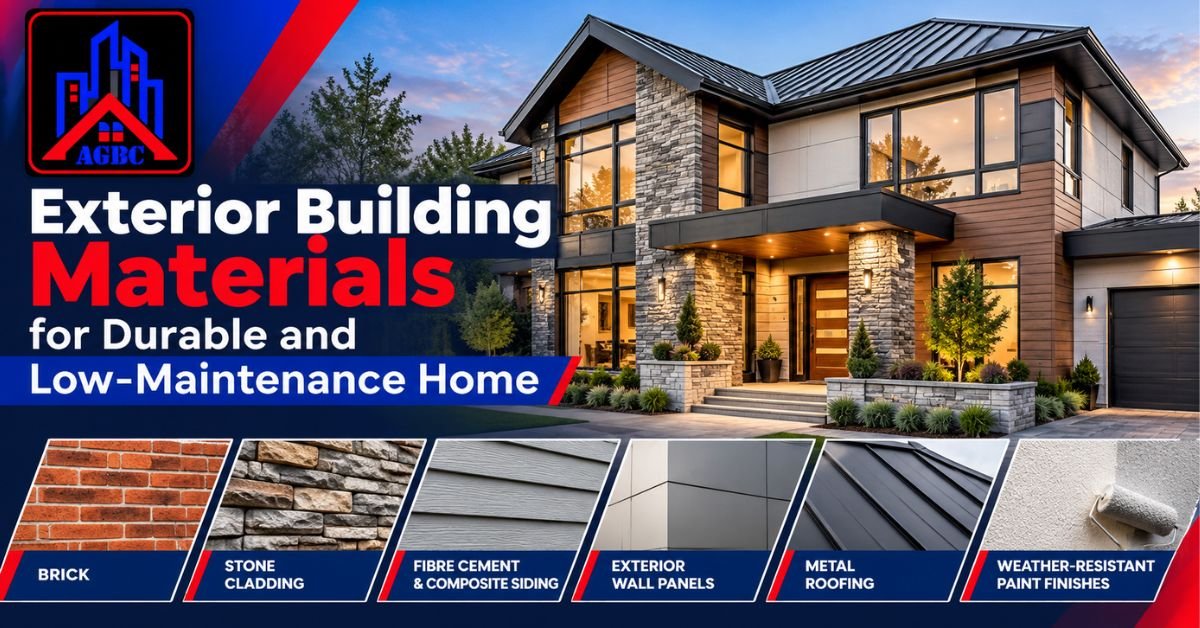
A low-maintenance house does not need a lot when you move in. The outside takes the weather, so the inside remains serene. In Rajasthan, that means fierce sun, dust, monsoon rain, and large variations between day and night. Leaking terraces, damp patches and cracked plaster are often the result of decisions taken months before about the materials used.
Exterior building materials that home builders select today must withstand heat, water and movement without constant repair. This guide contains 10 of these materials, and all are from the product range of AGBC, a supplier based in Udaipur. We began by browsing its product pages, so each item we list below is a real listing. We also looked at Bureau of Indian Standards (BIS) documents, a government energy-code training deck and a government fly ash report for the standards behind them. Well, let’s see.”
Quick List: 10 Exterior Materials for a Low-Maintenance Home
- AAC blocks.
- Concrete Bricks
- Bricks Fly Ash
- Cement panels, Aerocon panels
- Ready-mix cement plaster
- Fibre-mesh
- Water repellent (silane-siloxane)
- Flexible terrace coverings
- PUF Panels
- Mild steel hollow sections and pipes
What Makes an Exterior Low-Maintenance?
Before you purchase any outside material, check it against these six points:
- Waterproof. Most long-term damage is caused by water, so the surface should be resistant to that, or the system should shed it.
- Cracking control. Water can seep in through hairline cracks. Good plaster, mesh, and flexible coatings will limit them.
- TEMPERATURE REGULATION. Cooler walls and roof, less stress on the structure and the family.
- Corrosion resistance. If steel is exposed, it must be protected or the right material chosen.
- Simple repair. Choose products that can be patched and recoated without rebuilding.
- Standards. It gives you something concrete to check: a BIS standard number.
The Structure Behind the Surface
The exterior materials are only good if the frame behind them is solid. The supplier lists UltraTech, Wonder and Shree cement and TMT bars from Tata Tiscon, JSW Neosteel, Kamdhenu and others. The minimum yield stress of a bar grade as per IS 1786:2008 is the number following “Fe”. Cover blocks from 20mm to 75mm retain the concrete around the steel. Nominal cover as per IS 456:2000 depends on the exposure conditions, as this layer of concrete protects the steel from fire and corrosion. Exterior columns and beams are exposed to the weather, so don’t skimp on cover.
Wall Materials for the Outside
1. AAC Blocks
AAC stands for autoclaved aerated concrete. Makers cure the blocks in high-pressure steam, leaving tiny air pockets. They are thermally insulating and lightweight and are listed as IS 2185 certified on the homepage. These blocks are covered under IS 2185 (Part 3) of BIS. This is applicable to blocks having a density up to 1000 kg per cubic metre. Lighter walls mean less load on columns and foundations. The air pockets help the wall to resist heat, sound, and fire. The supplier also lists a block adhesive that joins the blocks in a thin layer.
2. Concrete Blocks
Concrete blocks are pre-cast blocks of cement, sand, aggregate, and water. They take impact well and work in load-bearing walls, non-load-bearing walls, and foundations, says the supplier. IS 2185 (Part 1) Hollow and Solid Concrete Blocks Suitable for external walls at ground level and for compound walls exposed to blows from vehicles and weather.
3. Fly Ash Bricks
Fly ash bricks are made from an industrial by-product of thermal power stations, mixed with cement, sand and water, pressed and steam-cured. The supplier says that the finish is smooth which reduces the amount of plaster you need. They also have policy support. In 1999, the Ministry of Environment, Forest and Climate Change (MoEF&CC) issued a notification (amended since) which required construction agencies within 300 km of coal or lignite power plants to use fly ash-based products. Confirm with your local authority whether your site falls within that radius.
4. Cement Panels and Aerocon Panels
Cement panels are boards made from prefabricated cement, sand and reinforcing fibres. Aerocon panels are sandwich panels with lightweight concrete in the middle and a fibre cement sheet on each side. The supplier says they are resistant to water, fire and termites and weigh less than masonry. Panels come in set sizes and are good for partitions and extensions where speed is a consideration.
Plaster and Surface Protection
5. Ready Mix Cement Plaster
Plaster is the outside skin of your wall. The supplier has ready-mix cement plaster, which is a factory blend of cement, graded sand, and polymer. All you add is water, removing the guesswork of mixing on site. Strong mixes do not have weak spots that crack or leak water.
6. Fibre Mesh
The supplier lists rolls of plaster fibre matting. The mesh is embedded into the plaster layer to distribute stresses due to shrinkage and movement. Position it at an intersection of different materials, like where a block wall meets a concrete column, because those are the joints where cracks tend to start.
7. Silane-Siloxane Water Repellents
Zycosil Plus and Zycosil Max are silane-siloxane liquids from Zydex. Per the supplier’s listing, the product penetrates concrete and brick to form a breathable barrier, meaning the wall can breathe and shed water but won’t trap moisture. Apply to a clean, dry surface according to the maker’s directions. These are all from the product listing, so take them as the maker’s claims and ask for coverage rates and application steps.
Roof and Terrace Materials
8. Flexible Terrace Coatings
Terraces take the brunt of sun and monsoon. The supplier lists ElastoMax, a flexible coating listed to bridge cracks up to 2.5 mm, and the homepage lists Zydex ElastoStretch Single Component as flexible and crack-bridging. Waterproofing is also known as Dr Fixit. Flexible coatings move with the slab as it expands and contracts with temperature. Ask how many coats and what kind of primer the manufacturer recommends.
9. PUF Panels
PUF = polyurethane foam. A PUF panel is a lightweight, prefabricated sandwich panel with a foam core. The supplier provides roofs, walls, ceilings, and floors in industrial, commercial, and modular construction (and the roofing page also shows a category for galvanised profile sheets). Roof and wall insulation are methods of increasing thermal resistance, and a lower U-value means better insulation, according to government training material for the Energy Conservation Building Code 2017. Before you compare options, ask the seller for the panel thickness and thermal data.
Metal and Outdoor Fixtures
10. Mild Steel Hollow Sections and Pipes
Gates, grills, railings and sheds need metal that will withstand the weather. The supplier lists MS pipes, rectangular hollow sections, channels, beams, angles, flats and round bars. Its channels, beams and flats are claimed to conform to IS 2062 standards. Mild steel is easy to cut and weld, but exposed steel requires a protective coating, so ask your supplier about primer and paint with your order.
Two more outdoor items to know about. The supplier offers HDPE water tanks with UV protection for above-ground and underground installation and SWR, CPVC, and UPVC pipes from Jain Plumbing, Ashirvad, and Supreme. SWR pipes carry soil, waste, and rainwater.
Exterior Building Materials Home Builders Should Compare Before Buying
Use this quick map to match each exterior part with a material.
- Walls. Lightweight, insulating walls from AAC blocks. Concrete blocks for compound wall & foundation. Fly ash bricks for smooth surface finishing.
- Surface: Use ready-mixed plaster with fibre mesh at joints, followed by a water-repellent coating.
- Roof and terrace. Flexible coating on slabs and PUF panels for the places where you need an insulated, light roof.
- Gates and fences! MS hollow sections with protection coating.
- Tanks and rainwater. SWR Pipes for rainwater and HDPE tanks with UV protection.
A Simple Yearly Maintenance Routine
Low maintenance is not the same as no maintenance. A little annual routine keeps problems small:
- Pre-monsoon: Look for hairline cracks in the walls and terrace. Keep drains and rain pipes clean.
- Post-monsoon. Look for damp patches, peeling paint, or stains. Catch them young.
- Yearly. Repaint any exposed steel that has lost its paint.
- Every couple of years. Ask the manufacturer of the product how often they recommend re-application of a water-repellent or terrace coating.
How to Buy Exterior Materials
- Start with the drawing. Your engineer determines the type of wall, thickness of plaster, and detail of the roof.
- Request the standard. Look for IS numbers like IS 2185 for bars and IS 1786 for TMT bars.
- Request Application Info. Request written coverage, coats, and cure times for chemicals.
- Select matching accessories. The block adhesive, fibre mesh, primers and cover blocks are as important as the main material.
- Get a quote delivered. Request GST, goods and unloading on separate lines. The AGBC site has ‘Get Price’ links and an inquiry form, and claims to respond with bulk pricing within two working hours. Take that for a statement by the company itself.
- Look for the ISI mark. Check the manufacturer through the BIS Care app with the licence number.
Before You Order
A durable exterior is a system. A sound frame, a good wall, a well-mixed plaster, a protective coat, and a flexible terrace. Match the layers to the weather, check each standard number, and maintain a simple yearly routine. For the full range, sizes, and catalogues, visit AGBC at the AGBC website.
FAQs
What are the best exterior building materials for a home?
There is no one right way. Match the material to the job: blocks or bricks to make up the walls, plaster with mesh for the skin, a water repellent for surfaces, and a flexible coating for the terrace. Follow the engineer’s drawings.
Which wall material helps keep a house cooler?
The supplier says AAC blocks are thermally insulating. Government energy-code training material lists wall and roof insulation as ways to increase thermal resistance. Ask what the block grade is and what your engineer recommends for wall thickness.
Do I need fibre mesh in exterior plaster?
The supplier claims the fibre mesh distributes the stress from shrinkage and movement. Many builders put it at joints between different materials, where cracks often start. Ask your engineer where it is correct for your walls.
How do I stop terrace leaks?
Use a flexible waterproof coating that is suitable for roofs. The supplier lists ElastoMax, rated to bridge cracks of up to 2.5 mm, and Dr Fixit products. Ask for primer, the number of coats, and curing time.
Are fly ash bricks mandatory?
The MoEF&CC notification says construction agencies within 300 km of coal or lignite power plants must use fly ash-based products. Check with your local authority to see if your site is included.



Leave a Reply